Services

On the job
Mrs. Jerry, caring for Leo at one and a half months
This is what a newborn placement looks like in a real home: a calm, experienced professional who knows how to feed, soothe and settle a very young baby — and who keeps the day logged so the whole family stays on the same page.
- Seasoned baby nurses — most with 15+ years of newborn work.
- Feeds, soothing, safe sleep and gentle routines from day one.
- Day and overnight coverage, with clean handoffs between specialists.

Baby Nurse
Day and overnight newborn care — feeding support, soothing, safe sleep, and gentle routines so parents can rest.
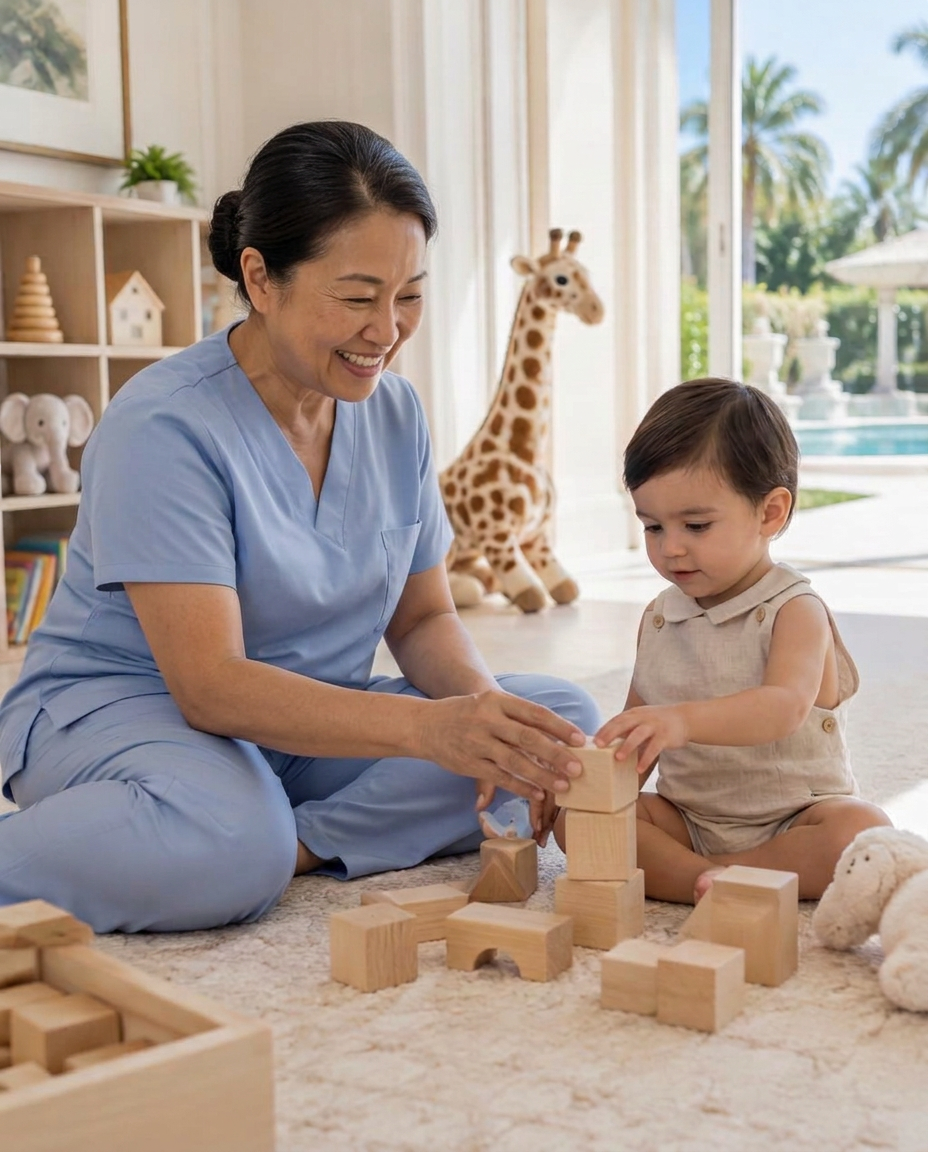
Toddler Nanny
Warm, developmental care for toddlers — creative wooden and Montessori play, early learning through songs and books, routines, meals, naps, and outings.

Weekend Nanny
Reliable weekend care for preschoolers and elementary-age siblings — activities, reading, homework help, and family events.
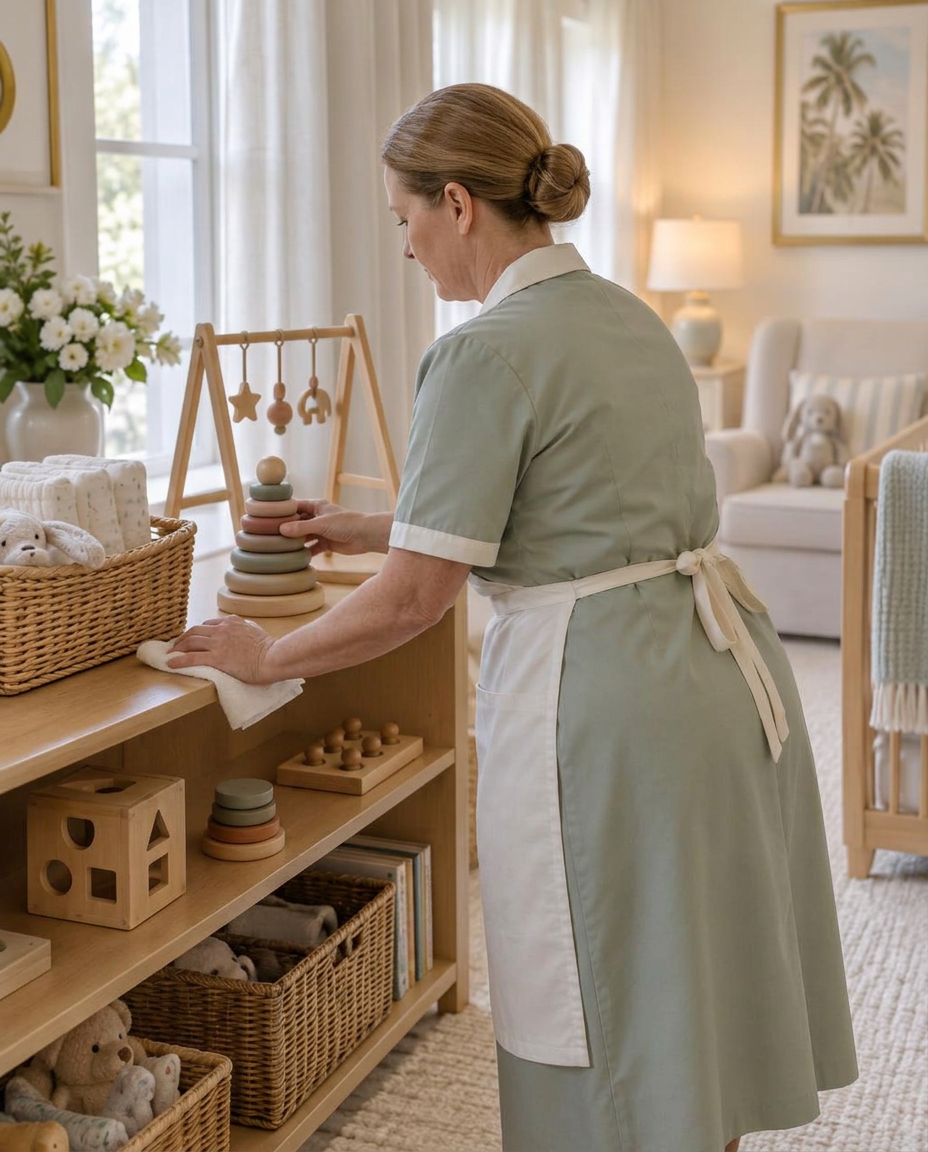
Housekeepers
Professional housekeepers between 30 and 45 years old to assist the family with household needs — nursery upkeep, sanitized bottles and toys, laundry, and tidy rooms between feeds and naps.
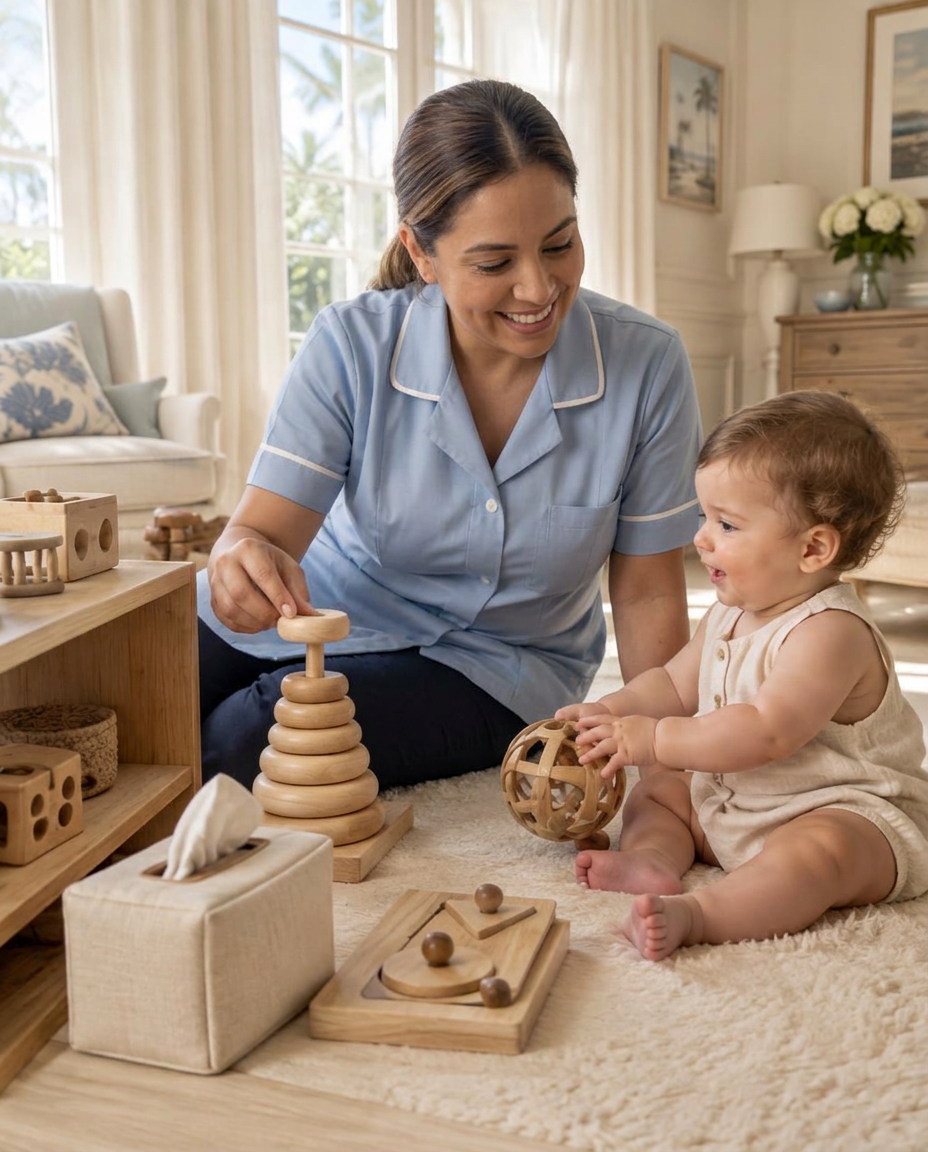
Open-ended play, at your child's pace
Our nannies plan play with your little ones using age-appropriate, open-ended materials — including wood, cloth and safe everyday objects. Families can browse and buy play kits directly from Lovevery ↗ — an independent third-party shop. We are not affiliated with it and no purchase is required for our care.
- Sensorimotor play for infants — reaching, grasping, tummy time, tracking.
- Creative play — stacking, sorting, open-ended building, first pretend play.
- Early learning woven into the day — language, counting, songs and books.
- Quiet focus at the child's pace, every toy matched to the current stage.
- Every shelf kept clean, ordered and beautifully arranged — part of our standard.
Household support
Professional housekeepers, 30–45
Every housekeeper we refer is a working professional between 30 and 45 years old, used to the rhythm of a busy family home. She assists with your household needs so the house keeps running — while the baby nurse or nanny stays focused on the children.

What she handles
- Nursery and children's rooms kept tidy between feeds and naps.
- Bottles, pump parts and toys washed and sanitized on schedule.
- Family laundry — washing, drying, folding and putting away.
- Linens changed, bathrooms refreshed, surfaces kept clean.
- Supplies and groceries restocked; simple meals prepared.
- Common areas reset after guests, nannies and evening staff.
How we place them
- Professional private-house experience, checked and referenced.
- Full name, date of birth and SSN for a national background check.
- Interviewed by our team before she is ever shown to a family.
- Clear duties agreed in writing — household support, not childcare.
- Housekeeping never replaces care: when a baby needs attention, the baby comes first.
Rotational coverage
Two newborn-care specialists, 12-hour shifts
For around-the-clock placements we send a pair, not a person. Two Newborn Care Specialists rotate every twelve hours — days and nights — so your baby is always with someone alert and steady, and no one is ever asked to be heroic for a full day and night alone.
Light, feeds & recovery
- Morning feed, bath and supervised tummy time on your schedule; outdoor time follows your pediatrician's advice.
- Naps, wake windows and age-staged wooden play between sleeps.
- Time for mom to shower, eat, or nap — with nothing to carry.
- Family-chosen shared log updated before the night specialist arrives.
The quiet hours
- Feeds follow your baby's cues and your pediatrician's plan, not a fixed overnight interval.
- Diapering, soothing, and every return to a safe sleep position.
- Gentle sleep conditioning — the same settling words all night.
- First morning feed, then the nursery handed back clean and calm.
Fifteen minutes together
- Both nurses awake, bottles sterilized and staged for the next feed.
- Spoken summary, then the shared app or paper log reviewed together.
- Nothing is assumed: intake, sleep, output, weight, instructions.
- Parents are never the message carrier between two caregivers.
What every handoff covers
Fifteen minutes of overlap, both nurses awake, bottles already sterilized and staged for the next feed. The outgoing specialist gives a spoken summary and reviews the family-chosen app or paper log with the incoming specialist. They confirm feeds, sleep, concerns and family instructions aloud; parents can read the same record rather than carry messages between shifts.
Every feed — ounces taken, bottle or breast, formula or lot used
Sleep — naps, wake windows, and the settling method that worked
Output — wet and dirty diapers, and anything worth watching
Health — temperature, weight trend, skin and cord notes
Equipment — what is sterilized and staged, what needs refilling
Family — appointments, travel, guests, and your requests
Same protocols, both nurses — every specialist works from your family's written plan, so a change of hands never means a change of method.
Choosing your route
How the team works — and which route keeps everyone rested
A tired caregiver is a less careful caregiver, and an exhausted mother heals more slowly. Pick the route that matches your baby's needs and how much sleep your household needs — we build the schedule so no one runs on empty.
Nights only
e.g. 9 PM – 7 AM, 5–7 nights a week
Best for: Healthy single babies, parents who can manage days, mothers who want full nights to recover.
Rest built in: Specialist sleeps during the day at home; nights off are covered by a second specialist or by the family.
Two specialists, 24/7
7 AM – 7 PM and 7 PM – 7 AM
Best for: Twins, preemies, hard-to-feed or reflux babies, C-section recovery, parents who travel or work.
Rest built in: Each specialist works one 12-hour shift and is fully off the other 12 — no one covers a day and a night.
Live-in, with protected rest
Up to 5 days on, then a relief specialist
Best for: Families who want one familiar face and have a private room for the specialist.
Rest built in: A guaranteed daytime rest block every day, a private room, and a set relief schedule for days off.
A live-in day is not 24 hours of work. The specialist works about 16 paid hours; the other 8 are for sleep and rest. Mom or another family member covers the baby for about 4 hours, split into blocks, so the specialist can nap and stay rested for the whole placement.
A day with the team
- 6:45 AMHandoff — night specialist briefs the day specialist and signs the log.
- 7 AM – 12 PMMorning feeds, bath, tummy time; mother sleeps in or rests.
- 12 – 5 PMNaps as needed, any pediatrician-requested weight check, bottles cleaned and ready.
- 5 – 7 PMFamily time, evening feed, calm bedtime routine begins.
- 6:45 PMHandoff — day specialist briefs the night specialist.
- 7 PM – 7 AMNight feeds and settling in the nursery; parents sleep through.
How we keep anyone from burning out
- No specialist works more than one 12-hour shift in 24 hours.
- Every specialist gets at least one full day off each week, covered by a familiar relief.
- Live-in placements include a guaranteed daily rest block and a private room.
- Parents get protected sleep — at least one full night's stretch, every night.
- If your baby's needs grow (reflux, feeding trouble, twins), we move you to the two-specialist route.
- Your consultant checks in weekly with both the family and the team.
Ready before baby comes home
Newborn-care equipment checklist
Every specialist arrives with a clinical kit — thermometer, sterile cord-care supplies, gloves and a paper log template if your family prefers one. These are the things we suggest having ready in the nursery, so the first shift begins with feeding, not shopping.
Feeding & sterilizing
- Countertop bottle sterilizer (steam or cold-water tablets)
- Bottle warmer with precise temperature control
- 8–12 bottles — 2 oz and 4–5 oz newborn sizes, plus 8 oz to grow into
- Nipples at the correct slow-flow stage for your baby's age
- Formula dispenser or measured discs, and a labeled breast-milk supply
- Breast pump, correctly sized flanges, and a dedicated fridge or cooler
- Bottle brushes, a draining rack, and nursery drinking water
- Burp cloths (10+), nursing pads, nipple cream, a feeding pillow
- Baby scale if your pediatrician recommends home weight checks
Safe sleep & monitoring
- Hospital-style bassinet, firm mattress, fitted sheet only
- Swaddles or sleep sacks (arms out in the early weeks), no loose blankets
- Sound machine and a dim red night light for night feeds
- Video monitor with night vision in the nursery
- Room thermometer and humidity monitor
- A second bassinet or travel crib for the parents' room and trips
Care & hygiene
- Fragrance-free baby wash, lotion and a barrier diaper cream
- Diapers in two sizes and unscented wipes, stocked and sorted
- Nail file or clipper, soft brush, saline and a nasal aspirator
- Digital or temporal thermometer and a baby first-aid kit
- Gentle detergent for baby linens, and a hamper for wet clothes
- Changing-pad covers and a caddy that travels between rooms
For mother & recovery
- A feeding chair that supports your back, with a side table
- Water bottle, snacks and a phone charger within arm's reach
- Peri bottle, pads and anything your doctor has recommended
- Pediatrician contact card and the hospital discharge summary
- A small nursery tray — tea, a blanket, somewhere to sit at 3 AM
Protecting a brand-new immune system
Newborn health protocol — before and after hiring
A newborn's immune system is still developing, and babies can't receive some vaccines themselves until they are older. The strongest protection in the first months is a "circle" of vaccinated, healthy adults and good everyday hygiene. Every step below carries the published source it follows — CDC, AAP or ACOG — with the date that source was published or last reviewed.
One note before you read on
Please confirm the vaccination, illness-prevention and newborn outdoor-care plans in this section with your pediatrician before you put them into practice. Guidance can vary by baby — a newborn born early, feeding a certain way, or with any health history may need a different plan than the general guidance shown here. Bring this list to your next visit and follow your doctor's advice over anything on this page.
Before hiring
Caregiver vaccinations & health
- Current-season flu shot on record. CDC names nannies and babysitters among the caregivers who should be vaccinated, because babies under 6 months are at high risk of serious flu complications and are too young to receive the flu vaccine themselves.CDCVaccines for Family and Caregivers· June 5, 2024
- Tdap (whooping cough) booster on record. Whooping cough is most dangerous in the first months — babies don't start their own whooping cough vaccines until 2 months old.CDCVaccines for Family and Caregivers· June 5, 2024
- Up to date on MMR and other routine adult vaccines — CDC recommends adults have at least one documented MMR dose, or other evidence of immunity.CDCMeasles Vaccination· Apr. 29, 2026
- TB screening on request. CDC advises testing people at higher risk, and a newborn's arrival is a reasonable moment to ask.CDCTesting for Tuberculosis· June 17, 2024
- Current on the COVID-19 vaccine where their own clinician recommends it, and a clean bill of health for the household.Checked case by case
- Records shared with the family before the first shift — ideally two weeks ahead, since CDC notes it takes about two weeks after vaccination for protective antibodies to develop.CDCWho Needs a Flu Vaccine· Sept. 18, 2025
Before baby comes home
The family's circle
- Parents, grandparents, older siblings and household staff get their seasonal flu shot and their whooping cough boosters if due — CDC calls this a circle of protection around the baby.CDCVaccines for Family and Caregivers· June 5, 2024
- During pregnancy, Tdap is recommended in every pregnancy at 27–36 weeks, and a flu shot in any trimester, so protective antibodies pass to the baby before birth.ACOGThe Tdap Vaccine and Pregnancy· last reviewed April 2026ACOGThe Flu Vaccine and Pregnancy· last reviewed November 2025
- Ask your pediatrician about RSV protection. CDC recommends every baby be protected against severe RSV — either through the maternal vaccine in pregnancy or a long-acting antibody after birth; most babies don't need both.CDCImmunizations to Protect Infants (RSV)· Aug. 18, 2025
After hiring — every shift
Clean, not sterile
- Handwashing with soap for 20 seconds before touching the baby, before every feed and after every diaper.CDCAbout Handwashing· Feb. 16, 2024
- Bottles, nipples, caps and pump parts cleaned after every use and sanitized at least daily — and sanitized every day for babies under 2 months, born premature, or with a weakened immune system.CDCHow to Clean, Sanitize, and Store Infant Feeding Items· Mar. 19, 2025
- Vitamin D drops, as your pediatrician directs. Breast milk alone usually doesn't provide enough vitamin D, so babies fed breast milk, or breast milk plus formula, need 400 IU of vitamin D every day starting shortly after birth. Babies drinking 32 oz or more of formula a day usually don't need drops. The specialist gives the exact dose with the dropper that comes with the product and logs it every day, so nobody gives a double dose.CDCVitamin D | Infant and Toddler Nutrition· Apr. 14, 2026AAPWhere We Stand: Vitamin D & Iron Supplements for Babies· updated May 24, 2022
- A caregiver with fever, cough or stomach symptoms stays home until symptoms are improving and there has been no fever for 24 hours. We send a covering specialist so the baby is never unattended.CDCPreventing Spread of Respiratory Viruses When You're Sick· Aug. 18, 2025
- No kisses on the baby's face, and no one who is unwell holds the baby — CDC lists direct contact like kissing the face, and touching a contaminated surface then the face, as how these viruses travel.CDCHow RSV Spreads· Feb. 20, 2026
- Visitors are kept to a small, well circle in the first weeks, and everyone washes or sanitizes hands before holding the baby.CDCPreventing Respiratory Illnesses· Aug. 18, 2025
- The goal is a clean, calm home — not a sterile one. Everyday living is part of healthy development; hygiene is focused where germs actually spread: hands, feeding gear and sick contacts.Our practice
After the first weeks
Fresh air, safely
- Short outdoor walks are fine for healthy newborns once your pediatrician agrees — many families start in the first month.Ask your pediatrician
- No sunbathing. The AAP recommends keeping babies under 6 months out of direct sunlight — take the shade instead, early morning or late afternoon.AAPSun Safety: Information for Parents· updated Aug. 9, 2024
- Light, breathable clothing that covers the arms and legs, a brimmed hat that shades the neck, and a stroller canopy.AAPSun Safety: Information for Parents· updated Aug. 9, 2024
- Never a blanket draped over the stroller for shade — it traps heat. Newborns can't cool themselves the way adults do.Our practice
- In the first months of flu and RSV season, keep it quiet: fewer busy indoor places, and anyone who is unwell stays away from the baby.CDCPreventing Respiratory Illnesses· Aug. 18, 2025
- A rectal temperature of 100.4°F (38°C) or higher in a baby under 3 months is always a same-day call to the pediatrician — AAP treats rectal readings as the most accurate in young infants.AAPFever and Your Baby· updated Sept. 23, 2025
Sources we follow, with dates
The full list of published guidance behind the protocol above. Dates are when each organization published or last reviewed the page.
- CDCVaccines for Family and Caregivers· June 5, 2024
- CDCMeasles Vaccination· Apr. 29, 2026
- CDCTesting for Tuberculosis· June 17, 2024
- CDCWho Needs a Flu Vaccine· Sept. 18, 2025
- ACOGThe Tdap Vaccine and Pregnancy· last reviewed April 2026
- ACOGThe Flu Vaccine and Pregnancy· last reviewed November 2025
- CDCImmunizations to Protect Infants (RSV)· Aug. 18, 2025
- CDCAbout Handwashing· Feb. 16, 2024
- CDCHow to Clean, Sanitize, and Store Infant Feeding Items· Mar. 19, 2025
- CDCVitamin D | Infant and Toddler Nutrition· Apr. 14, 2026
- AAPWhere We Stand: Vitamin D & Iron Supplements for Babies· updated May 24, 2022
- CDCPreventing Spread of Respiratory Viruses When You're Sick· Aug. 18, 2025
- CDCHow RSV Spreads· Feb. 20, 2026
- CDCPreventing Respiratory Illnesses· Aug. 18, 2025
- AAPSun Safety: Information for Parents· updated Aug. 9, 2024
- AAPFever and Your Baby· updated Sept. 23, 2025
This is general education, not medical advice, and it is not a substitute for your own doctor's guidance. Vaccination is always a personal decision for each caregiver and family, and newborn outdoor care depends on your baby — please review every step with your pediatrician and your own doctor.
The placement journey
Sleep training at 0–3 months, baby nanny from three months up
A placement is not a one-off — it steps up as your baby grows. A Newborn Care Specialist holds the first weeks and months and teaches your baby to sleep, then a baby nanny takes the day from around three months, and a toddler nanny from twelve. Most families keep going, and the terms usually go higher from there.
Newborn Care Specialist
Feeds, weight & gentle sleep training
- Feeds recorded in the family-chosen app or paper log at every shift.
- Safe sleep settled in from the first week — the same words, every time.
- Gentle sleep conditioning begins once feeding and weight gain are steady.
- Mother recovers: overnight nights, or a full live-in rotation of two nurses.
Baby Nanny
The daytime handover — the routine holds
- The sleep plan your specialist built carries into the day, unchanged.
- Wake windows, age-staged wooden and Montessori play, tummy time, language.
- The same family-chosen log continues; weight checks follow the pediatrician's advice.
- Outings, travel and second homes — your nanny comes with you.
Toddler Nanny
Where most placements go higher
- Terms usually step up, not down — more days, longer hours, then full weeks.
- First words and steps, gentle boundaries, two naps easing into one.
- Creative wooden and Montessori play — practical life, real tools, ordering, focus.
- Potty training, preschool preparation, and the older siblings in tow.
Book early · at least 3 months before baby's arrival
The best specialists are held before the due date
Booking a newborn care specialist at least 3 months before your baby arrives is always highly recommended — top specialists are reserved early, and the best matches go first. We can assist you with that: tell us your due date and we hold the right specialist for your arrival.
Our specialists usually stay with a family for 3–4 months. Then they transition out once their mission is accomplished — your baby sleep-trained through a healthy, gentle protocol, carried out with expertise. From there, the next stage of care steps in and the routine never resets.
How the transition actually happens
- Two to three weeks of overlap — the newborn specialist and the incoming baby nanny work the same days side by side.
- The family-chosen shared log is the handover: same fields, whether digital or on paper.
- Settling words, feed pacing, room setup and nap timing stay exactly as they were.
- Your consultant maps the transition weeks ahead, so it is never left to the last day of a term.
Handoffs · 3–4-month placements
How caregiver handoffs work — and how you stay informed
- Daily shift handoffs. When specialists alternate shifts, each handoff is a short in-person check-in covering feeds, sleep, diapers, any medicines or vitamin D, and anything the parents asked for.
- One shared log. Every feed, nap and note goes into the family's own tracking app, so parents see the same picture as the team, day or night.
- Weekly family check-in. A short review with the parents of progress, routine changes and any questions for the pediatrician.
- Planned end-of-placement handoff. Around months 3–4, the next caregiver is introduced early and overlaps with the specialist, learning the routine before taking over.
- No surprises. Any schedule change, relief caregiver or replacement is shared with the family in advance — parents approve every person who cares for their baby.
Newborn sleep support
Individual to your baby, coordinated with your pediatrician
There's no one-size-fits-all sleep plan. Every baby is different — in feeding, growth, temperament and health — so each plan is built around your baby and your family's wishes.
Feeding and growth come first. Sleep work begins only when your pediatrician is happy with weight gain and feeding, and the plan follows their guidance on night feeds.
Safe sleep every time. Baby sleeps on their back, on a firm, flat surface, in their own crib or bassinet with no loose bedding.
Gentle and gradual. Consistent routines, day–night rhythm and soothing that fits your parenting style — adjusted as your baby grows.
You decide. Parents approve the approach, see progress in the shared log, and anything unusual is raised with your pediatrician right away.
Learning through play
What the shelf looks like at every stage
Our nannies invite children to imagine with blocks, cloth, safe natural materials and everyday objects. Families can browse age-appropriate play kits at Lovevery ↗. It is an independent shop, not an agency partner, and you never need to buy a kit to make room for meaningful play. Here are ideas to adapt to your child's stage.
Our promise to families
Room to wonder. People to grow with.
Remember calling a friend to play tag, turning a box into a house, or finding a whole adventure in a few simple pieces? We want children to have space for that kind of freedom again. From the nursery onward, we listen to your family's needs and build a care plan around responsive conversation, outdoor movement, stories and imaginative play — with screens used thoughtfully, not as a stand-in for connection. Harvard's Center on the Developing Child describes playful, back-and-forth interactions as an opportunity to practice attention, self-control and relationships. We wish every family joyful days together and every child room to grow into a curious, caring person. No toy or routine guarantees an outcome; steady relationships and opportunities to play are what we can offer.
Research: Harvard Center on the Developing Child · Brain-Building Through Play · published Dec. 14, 2022 ↗ · AAP · The Power of Play · updated May 3, 2023 ↗ · AAP · Best Toys Go Back to Basics · Dec. 3, 2018 ↗ · AAP · Family Media Plan · updated Jan. 20, 2026 ↗
Download the free age-by-age play guide (PDF)Looking, listening, holding
- On the shelf
- High-contrast cards · an age-appropriate rattle · an unbreakable infant mirror
- What she does
- A card held 20–30 cm from the eyes and drifted slowly side to side in the alert window after a feed; the rattle tapped at the midline so she turns to find it; two minutes of tummy time over a rolled muslin with the mirror at eye level.
- What it builds
- Visual tracking, midline attention, neck strength, and the very first cause and effect.
Reaching and grasping
- On the shelf
- An age-appropriate grasping toy · a soft sensory ball · an infant-safe teether
- What she does
- The ring sits just within reach on the play mat so a swipe becomes a catch; the ball is rolled a hand-width away to start the reach; everything that comes to hand goes to the mouth — that is the work, not a mistake.
- What it builds
- Hand-eye coordination, the palmar grasp, oral exploration, and the first use of both hands together.
Passing, poking, finding
- On the shelf
- Large stacking cups · a soft ball · a muslin cloth for supervised peekaboo
- What she does
- A large toy passed from hand to hand; a ball partly hidden under a cloth for the baby to find; a caregiver nearby naming what happens.
- What it builds
- Pincer grasp, hand-to-hand transfer, object permanence, and the first long stretches of concentration.
Pulling, placing, solving
- On the shelf
- A large-piece shape sorter · a sturdy push toy for supported cruising · a lidded box
- What she does
- A large block dropped into a box and tipped out; supported cruising beside sturdy furniture; one large shape tried in a sorter, then the lid closed and reopened.
- What it builds
- Standing and cruising, in-and-out logic, learning to let go on purpose, and the patience to try again.
In, out, up and down
- On the shelf
- Large stacking rings · a small pitcher and spoon with large play pieces · a low carrying tray
- What she does
- Large pieces transferred between bowls under adult supervision; rings stacked then knocked down; a small tray carried from shelf to table.
- What it builds
- Concentration, the wrist rotation she will need later for writing, a sense of order, and the start of independence.
Practical life and pretend
- On the shelf
- Wooden animal figures · a small wooden broom and dustpan · a wooden kitchen set with a cutting board · lacing beads
- What she does
- Watering the plants with a little wooden can and sweeping the crumbs after a snack; feeding a wooden doll and setting its place; threading a lacing bead while naming each color out loud.
- What it builds
- Language, early counting and colors, empathy and role play, and the fine-motor control a pencil will need.
How she chooses the next toy
- Offer a few choices and follow the child's curiosity; a toy does not need to teach only one skill.
- Check the manufacturer's age and safety guidance, then adapt play to the child's abilities.
- Wood, cloth or other safe materials can all invite play; the important part is the child's interaction with a caring adult.
- Open-ended over instructional. A wooden ring is a plate, a steering wheel, or the base of a tower.
- Safety before beauty: no small parts or loose pieces for children under three, no splinters, and no cords or ribbons that could entangle a child.
- A short shelf, rotated often — six things out, the rest in a basket, so attention doesn't scatter.
How she keeps them clean
- Anything that reaches the mouth is cleaned after every session: warm soapy water, a food-safe sanitizing wipe, then air-dried upright.
- Wood is never soaked, boiled or put on a radiator — it warps and splinters. A damp cloth, mild fragrance-free soap, dried straight away.
- Cloth and muslin pieces go into a wash bag on a gentle cycle and dry in the sun.
- The shelf itself is wiped at the end of every shift, and the whole set is deep-cleaned once a week.
- Before play, a thumbnail runs over every piece. A chip, a crack or a loose peg means the toy leaves the room that day.
- In a shared home, mouth toys are individual and cleaned between children; a sick child's set is put aside and deep-cleaned before a sibling touches it.
- If your family has its own cleaning protocol, she follows yours.
School-age & elementary
Young, energetic nannies — learning happens outdoors
For children ages 5–12, we place active nannies from many backgrounds who keep up on the lawn, at the beach and after school — and turn every afternoon into hands-on learning, with screens kept to a minimum.


STEM backyard labs
Bug hunts, plant journals, baking-soda volcanoes and simple circuits — real experiments with a notebook to record what happened.
Math & word movement games
Chalk math hopscotch, spelling relay races and scavenger hunts that turn homework facts into running, jumping play.
Building & engineering
Cardboard forts, marble runs, magnetic tiles and LEGO challenges with a goal: build a bridge that holds ten books.
Nature & outdoor exploration
Beach tide-pool walks, garden planting, bird spotting and map-making in the park — curiosity outside the classroom.
Creative arts & storytelling
Sidewalk murals, puppet shows, story dice and family newspapers that build writing and confidence.
Homework & reading routine
A calm after-school rhythm: snack, movement, homework help, then a daily reading habit — shared with you each evening.